



Many plastics processors think about purging as a reactive tool—something used only during color changes, contamination events, or major material transitions. But some of the biggest gains in efficiency come when purging is used before problems occur.
That is the idea behind preventative purging.
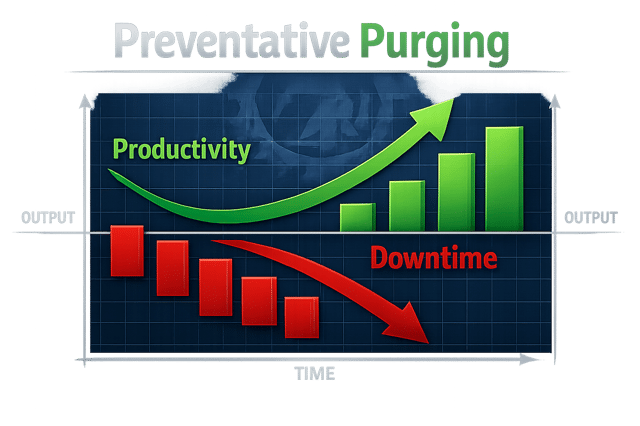
Rather than waiting for carbon buildup, black specks, or difficult screw pulls to disrupt production, preventative purging helps processors maintain cleaner machines, reduce scrap, and improve equipment uptime as part of a broader process discipline.
In many operations, it can be one of the simplest ways to improve part quality and protect profitability.
What Is Preventative Purging?
Preventative purging means using purging compounds proactively as part of routine processing and preventative maintenance, rather than only as a response to contamination or downtime events.
The goal is straightforward: prevent residue, degradation, and contamination from accumulating to the point where they affect production.
That matters because once buildup becomes severe, a purge may no longer be enough and manual cleaning—or even a screw pull—may be required. Those events are expensive in labor, downtime, and lost production.
Preventative purging is designed to help avoid getting there.
Why Reactive Purging Alone Can Cost More
Many processors unknowingly operate in a reactive mode. A machine runs until contamination appears, part quality drops, or maintenance issues force intervention.
The problem is that contamination often starts long before defects become visible.
Small amounts of residue or degraded polymer can gradually build up in screws, barrels, dies, or hot runners. By the time black specks or streaks show up in parts, the issue may already be advanced.
At that point, recovery often takes longer, consumes more material, and may require aggressive corrective action.
Preventative purging changes that equation.
By cleaning before contamination reaches that stage, processors often reduce both scrap and the frequency of major cleaning events.
How Preventative Purging Helps Reduce Scrap
Scrap reduction is often the first measurable benefit.
When machines remain cleaner, processors are less likely to encounter contamination defects during production or at startup. That can mean fewer rejected parts, less wasted resin, and more consistent output.
This can be especially valuable for processors running engineered resins, tight-tolerance parts, or clear applications where even minor contamination can cause rejects.
A cleaner machine tends to produce good parts more consistently.
And consistency is often where profitability lives.
Better Machine Availability, Fewer Screw Pulls
One of the biggest hidden costs in plastics processing is unplanned downtime.
Manual screw pulls and emergency cleaning events can consume hours or even days of production time. They also create risk, labor expense, and lost throughput.
Preventative purging can help reduce those disruptions by keeping contamination from accumulating to that point in the first place.
This is why many processors view preventative purging not simply as a cleaning practice, but as a way to improve machine availability.
And higher equipment availability often translates directly into higher output.
Preventative Purging as Part of Preventative Maintenance
The most effective programs treat preventative purging as part of routine preventative maintenance.
That might include scheduled purges based on resin type, production hours, contamination risk, or shutdown frequency.
It may also include sealing machines during extended downtime events to prevent oxidation and degradation during startup.
The idea is not more purging for its own sake.
It is smarter purging with a clear objective: avoid costly disruptions before they begin.
Why It Often Pays for Itself
Some processors see preventative purging as an added operating expense.
In practice, many find the opposite.
When measured against avoided scrap, reduced downtime, fewer screw pulls, and faster startups, preventative purging often delivers savings that far exceed the cost of implementation.
That is why it is often better viewed not as a maintenance cost, but as an efficiency investment.
Especially when resin prices are elevated, preventing waste becomes even more valuable.
A More Proactive Way to Run
The best-run operations often share a common mindset: they do not wait for problems to become expensive before addressing them.
Preventative purging fits that philosophy.
It supports cleaner equipment, more predictable processing, and better part quality—while reducing the likelihood of contamination events that disrupt production.
In other words, it is not just about cleaning machines.
It is about running them better.
Conclusion
Purging compounds are often associated with solving problems. But some of their greatest value comes from helping prevent problems from happening at all.
By incorporating preventative purging into routine operations, processors can reduce scrap, minimize downtime, and improve equipment availability before contamination forces costly corrective action.
Sometimes the best defense in plastics processing really is a good offense.
If your team is dealing with tough resin transitions or temperature swings, we can support you with a customized purge protocol. Request a free sample or schedule a consultation with one of our purging experts today.


.jpg?width=450&height=250&name=iStock-611291506%20(1).jpg)


Comments