



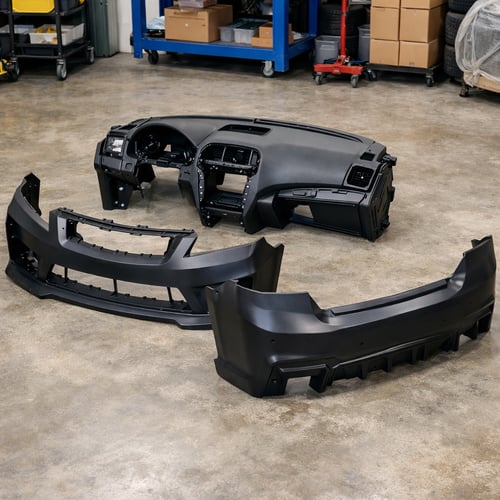
Automotive injection molders operate in one of the most demanding manufacturing environments. Tight tolerances, strict OEM requirements, and high production volumes leave little room for inefficiency.
Even small process issues—like contamination during a color change or material degradation in the barrel—can quickly lead to increased scrap, unplanned downtime, and missed delivery targets.
For many molders, the root cause isn’t the machine or the material. It’s the cleaning process between runs.
Why Scrap and Downtime Are So Common in Automotive Molding
Injection molding for automotive applications involves frequent transitions between materials, colors, and production runs. These changeovers create opportunities for residual resin and carbon buildup to accumulate inside the screw, barrel, and hot runner system.
Over time, that buildup leads to defects such as black specks, streaking, or inconsistent surface finish. In an industry where visual quality and consistency are critical, even minor defects can result in rejected parts or entire batches being scrapped.
The challenge becomes even greater when working with engineering-grade resins like nylon, polycarbonate, or glass-filled materials. These materials run at higher temperatures and are more prone to degradation, making effective cleaning both more difficult and more important.
The Role of Purging Compounds in Injection Molding
A purging compound is specifically engineered to remove residual resin, color, and carbon deposits from the molding system. Unlike standard resin purging, which often smears contamination rather than removing it, a dedicated purging compound is designed to displace and carry out buildup efficiently.
When used correctly, purging compounds clean critical components such as the screw, barrel, and hot runners without requiring full disassembly. This allows molders to maintain a cleaner process with less interruption to production.
More importantly, a clean machine produces more consistent parts. That consistency is essential for meeting automotive quality standards and reducing the risk of downstream defects.
The Real Cost of Inefficient Changeovers
Many injection molding operations underestimate the cost of poor purging practices. While the impact may not always be immediately visible, it shows up in several key performance areas.
Extended changeover times reduce available production capacity, while contamination during startup increases the number of rejected parts. Operators may spend additional time troubleshooting defects, and maintenance teams may need to perform more frequent tear-downs to remove buildup.
Taken together, these inefficiencies drive up labor costs, waste material, and reduce overall equipment effectiveness (OEE). In high-volume automotive production, even small improvements in changeover efficiency can translate into significant cost savings.
Why Automotive Applications Require a More Strategic Approach
Automotive injection molding presents unique challenges that make standard cleaning methods less effective. Many parts are produced using hot runner systems with tight tolerances, where even minor contamination can persist and cause recurring defects.
In addition, automotive components often have strict cosmetic and functional requirements. Interior parts, lighting components, and under-the-hood applications must all meet exacting standards for appearance and performance.
Because of this, reactive cleaning—waiting until defects appear—is not enough. Automotive molders benefit most from a proactive, process-driven purging strategy that prevents issues before they impact production.
How an Optimized Purging Process Improves Performance
When purging is treated as a core part of the production process rather than a last-minute fix, the results are measurable.
A well-optimized purging process reduces the time required for color and material changes, allowing machines to return to full production more quickly. It also minimizes contamination, which leads to lower scrap rates and more consistent part quality.
At the same time, regular purging helps prevent long-term buildup inside the machine. This reduces the need for manual cleaning and extends the life of screws and barrels.
The result is a more stable, predictable molding process—one that supports both productivity and quality goals.
Best Practices for Automotive Injection Molders
To achieve consistent results, automotive molders should approach purging as a standardized process rather than an occasional task. That starts with selecting a purging compound that matches the specific materials, temperatures, and equipment used in the operation.
Equally important is operator training. When teams follow a consistent purging procedure, the results become more predictable and repeatable across shifts and machines.
Preventative purging should also be built into regular production schedules. Addressing buildup before it becomes visible helps avoid defects and reduces the need for more aggressive cleaning later.
Finally, special attention should be given to high-risk areas such as hot runners and valve gates, where contamination is more difficult to remove and more likely to cause recurring issues.
The Bottom Line
Reducing scrap in automotive injection molding is not just about improving materials or upgrading equipment. In many cases, the biggest opportunity lies in optimizing the processes that support production—especially purging.
A strategic approach to purging helps molders reduce downtime, improve part quality, and maintain the consistency required by automotive OEMs. Over time, these improvements contribute to lower costs, higher efficiency, and a stronger competitive position.
For automotive injection molders looking to improve performance, a better cleaning process isn’t just maintenance—it’s a competitive advantage.
If your team is dealing with tough resin transitions or temperature swings, we can support you with a customized purge protocol. Request a free sample or schedule a consultation with one of our purging experts today.




Comments